


Most articles about Mediterranean resort communities focus on glamorous architecture and sunsets. This one doesn’t. Here, you’ll find the tools to evaluate these areas on your own terms, based on the criteria that actually determine whether the investment will hold its value for decades to come.
Las Colinas Nordic has been tracking the market from the inside for years. The pattern I see among serious buyers is clear: those who take the time to make systematic comparisons end up with decisions they feel confident about. Those who skip this phase regret their decisions more often than they’d care to admit.
This guide provides you with a framework for objectively comparing areas. Expect concrete evaluation criteria, realistic warnings, and practical questions you should ask before heading out to view a property.

Key Points: How to Compare Luxury Villa Communities in 2026
What distinguishes a good villa community from an average one?
An area may look appealing in photos and still turn out to be the wrong choice. The difference rarely lies in the obvious. It lies in details that only become apparent after the contract is signed.
The best neighborhoods share certain characteristics. They have clearly defined access controls. They have a management team that takes maintenance seriously. They have an established ownership structure that ensures stability over time. And they have amenities that are actually used, not just listed on paper.
Complexes that lack these elements may seem affordable at first. Over time, they often turn out to cost more, both in terms of money and frustration.
Why Security Is the Most Important Criterion
To put it bluntly: security isn’t just a matter of peace of mind. It’s a matter of property value. Areas with poor security experience more frequent break-ins, vandalism, and illegal squatting. In Spain, the latter can take months to resolve legally.
A gated community with 24/7 security, digital access control, and video surveillance offers you more than just peace of mind. It gives you freedom from worry. You can travel back to Norway without wondering if your home is empty and vulnerable.
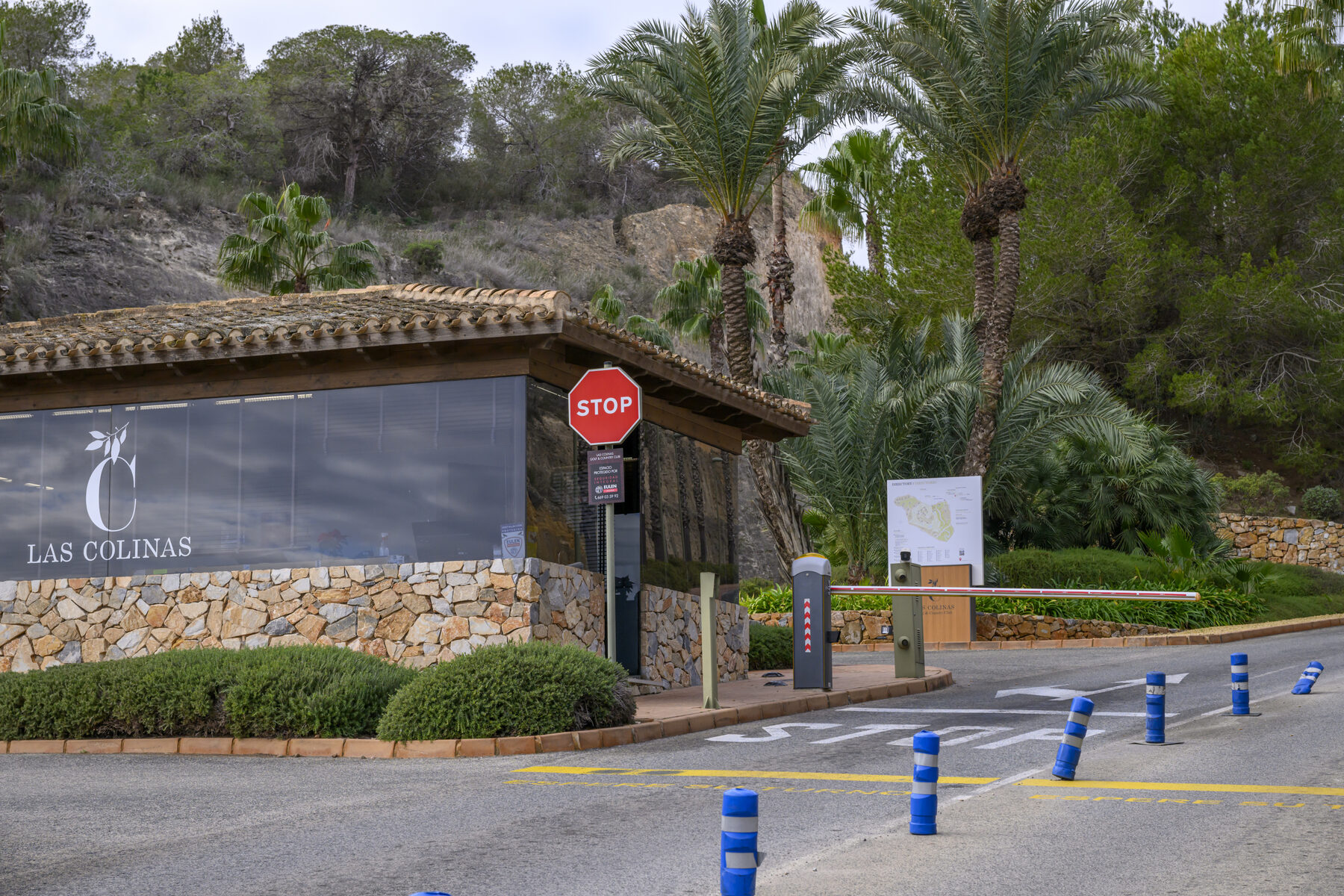
It gives you freedom from worry.
The estate entrance
What should you look for?
Ask if the area is staffed around the clock, not just during office hours. Find out if there is a registered access control system with logging. Check if there is video surveillance in the common areas. And most importantly: ask existing owners about their experiences.
Communities such as Las Colinas Golf & Country Club operate with a fenced perimeter and 24-hour security. Only owners and invited guests are allowed in. This model reduces the risk of unwanted incidents.
How to Properly Evaluate Location
Location isn’t just about distance to the airport or the beach. It’s about what you’ll actually use the property for, and how often.
Ask yourself: How many times a year do you plan to use the property? Are you coming primarily for golf, the beach, or both? Do you want access to restaurants and activities within the area, or do you prefer to drive to the city?
Three Questions About Location
First: What is the actual drive time to the airport? Not the listed time, but the time spent in traffic on a Friday afternoon in July. Second: Are there daily direct flights from Oslo, Bergen, or Stavanger? Third: What’s within a 15-minute drive, and what requires a full-day trip?
Areas on the Costa Blanca are often closer to Alicante Airport than areas on the Costa del Sol are to Málaga. This difference can save you hours in the car over time.

Utility Value: The Criterion Most People Underestimate
Utility value is a Norwegian concept that describes what the property actually gives you in return in terms of experiences, time, and quality of life. It is not the same as market value.
A villa can have high market value and low utility value if you never use it. Conversely, a moderately priced villa can offer tremendous utility value if the area provides amenities you actually use.
Amenities That Increase Utility Value
Golf is obviously relevant to many people. But what about tennis, padel, spas, and fitness centers? What about restaurants you’d actually want to visit more than once? What about a beach club that gives you access to the Mediterranean without having to fight for parking spots?
Resort-style villa communities that offer everything from a golf course to a private beach club score high on this criterion.
How to Compare Investment Quality
Investment quality is about more than just price trends. It’s about long-term stability, demand, and the area’s reputation among serious buyers.
At the same time, I’ll state the obvious: no one can guarantee future returns. But some areas have a track record that provides an indication. Areas with limited supply, high demand, and stable management have generally held their value better than areas with overdevelopment and inconsistent quality.
Questions You Should Ask
How many units are planned for the area in total? Is there a master plan that limits future development? Who manages the common areas, and what is the maintenance budget? What have prices been over the past five years, adjusted for inflation?
Areas that are nearly complete, with limited remaining vacant land, often offer greater predictability than areas in the midst of an expansion phase.
Checklist for Systematic Comparison
When evaluating multiple areas simultaneously, it’s helpful to organize the information. Below is a checklist you can use.
Common Mistakes When Comparing Areas
After assisting buyers through the process for years, I’ve noticed some recurring mistakes.
Mistake 1: Focusing solely on price per square meter
Price per square meter doesn’t tell the whole story. An area with a low price per square meter may have high common area fees, poor management, or limited amenities. The total cost over ten years is more relevant than the initial purchase price.
The total cost over ten years is more relevant than the initial purchase price.
Mistake 2: Underestimating the quality of management
Management is the invisible factor that determines whether a complex remains attractive over time. Areas with poor management fall into disrepair. Green spaces wither. Pools develop problems. Common areas lose their appeal. Always ask about the management company, budget, and track record.
Mistake 3: Ignoring the owner mix
An area characterized by short-term rentals has a different character than one dominated by permanent and part-time residents. Neither is necessarily wrong, but it should align with your expectations.
How Regional Differences Affect Your Choice
The Mediterranean stretches from Portugal to Croatia. Each region has its own distinctive features.
Spain: Costa Blanca versus Costa del Sol
The Costa del Sol, particularly the area around Marbella, has a longer history of luxury tourism. Prices reflect this. The Costa Blanca, especially the southern section from Alicante and southward, often offers comparable quality at a lower entry price, with shorter distances to the airport.


According to the property registrars, foreign buyers made 46.4% of home purchases in the province of Alicante in the second quarter of 2026.
Other Regions
France (Côte d’Azur) and Italy (Amalfi Coast, Tuscany) offer cultural richness but higher entry prices and complex tax rules. Greece (Mykonos, Santorini) has seen strong growth but can be seasonal. Croatia is on the rise, but infrastructure varies.
For Norwegian buyers who prioritize accessibility, direct flights, and a stable legal framework, Spain is often a strong choice.
Legal matters you must clarify
Don’t wait until the contract is ready. A good attorney will check for registered encumbrances, building permits, zoning plans, and the seller’s legitimacy.
NIE number and Spanish bank account
To buy property in Spain, you need an NIE number (Número de Identificación de Extranjero). You’ll also need a Spanish bank account for payments and ongoing expenses. Both processes take time, so start early.
Taxes and Fees
Buying property in Spain involves either transfer tax (ITP) or value-added tax (IVA), depending on whether the property is pre-owned or new. In addition, there are stamp duty, notary fees, and registration fees. In total, expect about 11% of the price on a resale and 13 to 14% on a new build; budget 14%.
Ongoing costs include property tax (IBI), any common area fees, and wealth tax on assets above a certain threshold. These vary by region and property value.
Financing for Norwegian Buyers
Several Spanish banks offer financing to non-resident buyers; the bank decides the share case by case. Interest rates and terms vary. Some buyers prefer to refinance through a Norwegian bank using a Norwegian property as collateral.
Las Colinas Nordic collaborates with financing partners that offer Norwegian buyers access to local loan terms. Ask about this option if it’s relevant to you.
Renting: Realities You Should Know
A word of caution: about renting, to put it bluntly. Many buyers expect rental income from day one. The reality is more nuanced.
In the Valencia region, lets of 10 days or fewer to the same guest for tourist purposes count as tourist lets (VUT, Vivienda de Uso Turístico) and need a favourable municipal planning report and registration. Processing times vary by municipality and can be long; ask your lawyer for the current wait before you plan on rental income. If your financial plan relies solely on rental income from year one, the timeline does not support that plan.
Long-term rentals
Long-term rentals (over one year) are subject to different rules and provide more predictable income, but a lower return per night. Consider which model best suits your usage patterns and expectations.
Areas with professional management and high standards attract quality tenants. This reduces the risk of problems and wear and tear.
Viewing Trip: What You Should Do Before You Go
A viewing trip is valuable, but only if you’re prepared. Before you travel, you should have done this homework.


Take time to think through the decision without pressure.
Lunch on the clubhouse terrace
How Las Colinas Nordic Assists Buyers
Las Colinas Nordic focuses on one thing: giving Norwegian buyers the foundation to make a decision they’ll feel confident about for decades, even if they ultimately conclude that Las Colinas isn’t the right fit.
We arrange viewing trips where you can experience the estate and meet current owners. We coordinate with independent attorneys and financing partners. And we follow up after the closing, providing support for up to 12 months.

Our approach is discreet and non-binding.
The goal is for you to feel confident in your decision, whatever it may be.
Conclusion: How to Make an Informed Decision About Villa Communities
Comparing luxury villa communities along the Mediterranean isn’t about finding the cheapest option. It’s about finding the community that meets your criteria for security, location, practical value, and investment quality.
Use the checklist in this guide as a starting point. Ask the questions that usually come up six months after the purchase, and ask them now. Verify the answers you receive through independent sources.
Ask the questions that usually come up six months after the purchase, and ask them now.
Good advice is always worth reconsidering. If you’d like to discuss your criteria with someone who knows the market from the inside, a casual conversation is always available. No showing, no obligation.
Frequently Asked Questions About Comparing Luxury Villa Communities
What is the most important criterion when comparing villa communities?
Security and access control are the most important criteria for most buyers. A community with 24-hour security and controlled access provides both peace of mind and protects property value over time. Las Colinas Nordic always recommends prioritizing this over price or aesthetics.
How do I know if a gated community is well-managed?
Ask about the management company, the annual maintenance budget, and the history of completed projects. Visit the common areas yourself and assess their condition. Talk to existing owners about their experiences. Good management is evident in the details.
What does “utility value” mean in practice?
Utility value describes what the property actually offers you in terms of experiences and quality of life. A home in an area with a golf course, beach club, and restaurants that you actually use has a higher utility value than an isolated villa without amenities. Las Colinas Nordic focuses on this criterion in all its recommendations.
Is it safe for a Norwegian to buy property in Spain?
Yes, provided you follow the proper process. Hire an independent Spanish attorney early on. Obtain an NIE number and a Spanish bank account. Verify all documents before signing. With the right preparation, the home-buying process in Spain is predictable and safe.
How long does it take to obtain a tourist rental license in the Valencia region?
Processing times vary by municipality and can be long; ask your lawyer for the current wait. If you’re planning tourist lets (10 days or fewer to the same guest), you shouldn’t base your finances on rental income from the first year. Las Colinas Nordic always provides realistic timelines in its consultations.
What distinguishes the Costa Blanca from the Costa del Sol?
The Costa del Sol has a longer history of luxury tourism and higher price levels. The Costa Blanca, particularly the southern part, often offers comparable quality with shorter distances to the airport and lower entry prices. Both regions have established villa communities with good infrastructure.
Should I buy through a company or privately?
This depends on your situation. Buying through a company may offer tax benefits for some, but it also involves administrative costs. The advice from Las Colinas Nordic is always the same: consult a tax advisor who is familiar with both Norwegian and Spanish regulations before making a decision.